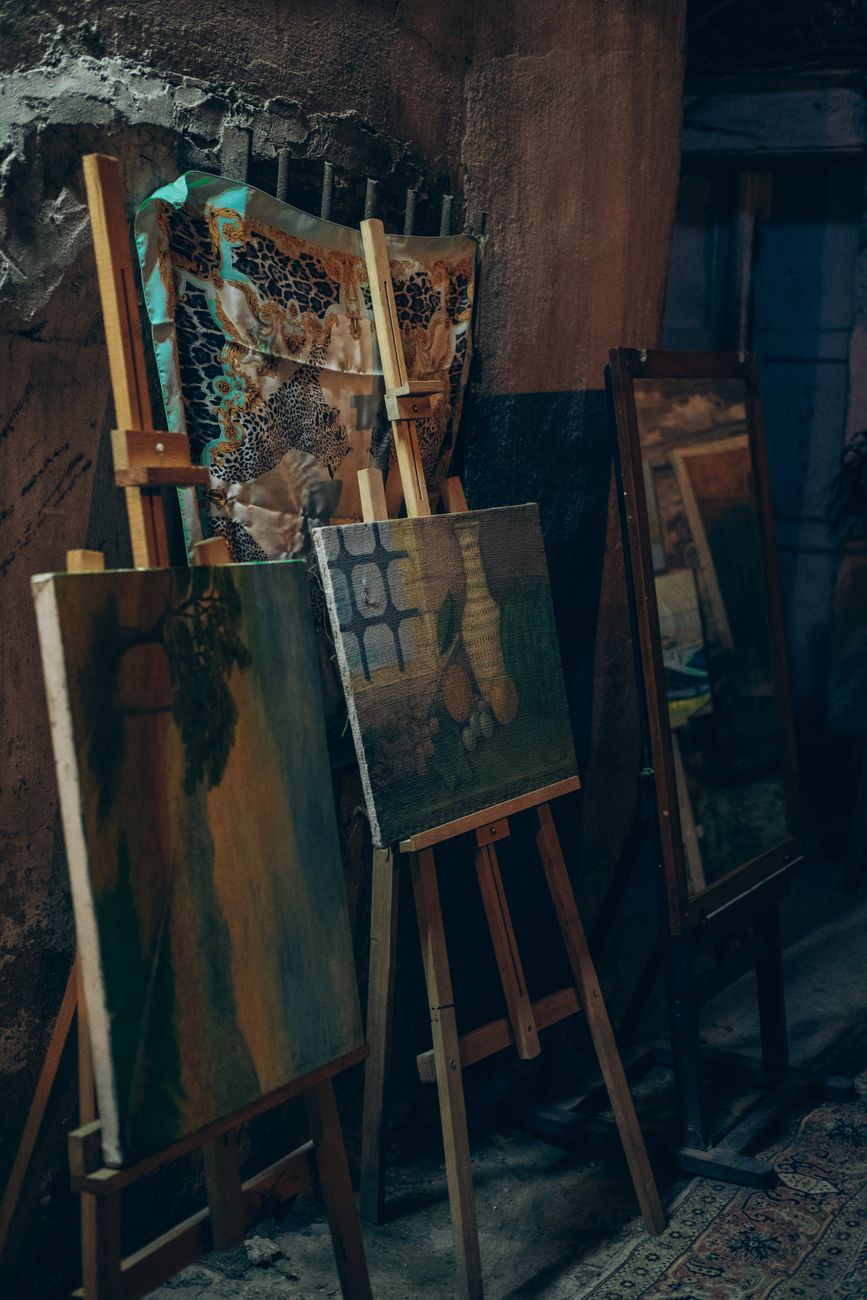
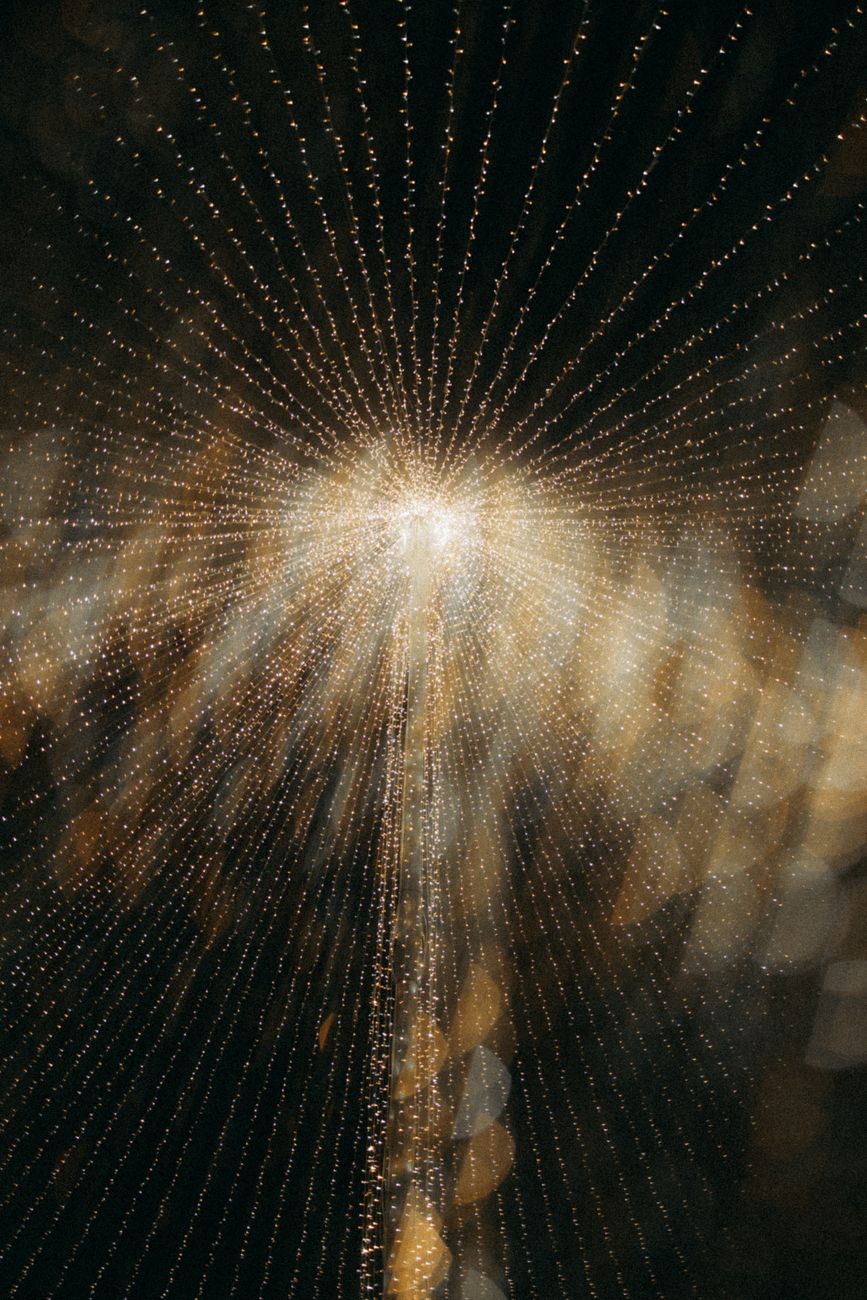
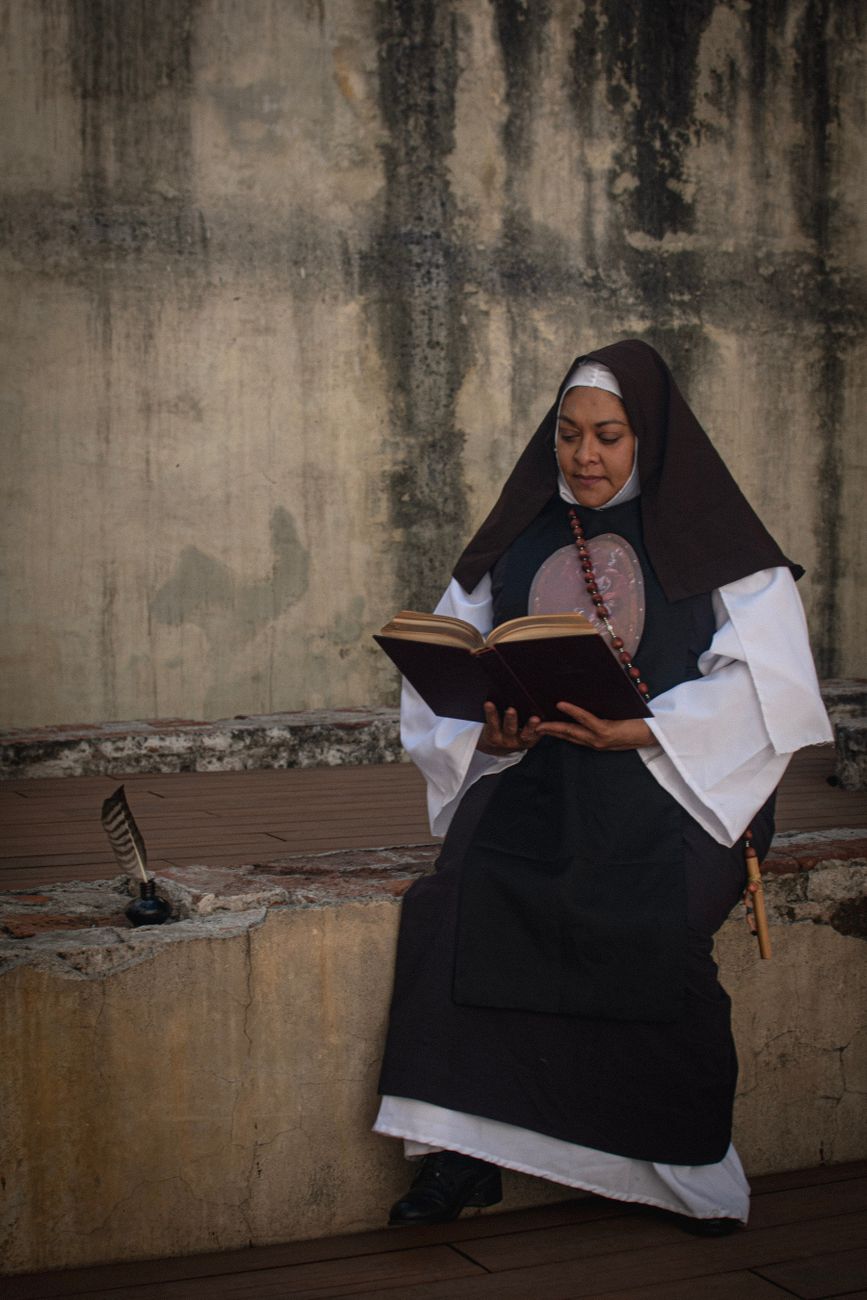
With strawberry blonde locks alight like flaming tongues, she descends into her basement studio to sit before her easel, its canvas tabula rasa made taut upon its frame in preparation, expectation, to receive her delicate brushstrokes intentionally touched.
Her eyes scan over tiny pots of paint like books arrayed on a library shelf – lapis lazuli, lingonberry, brick, clay her Dickinson, Derrida, Plato, Paul, some of these vessels well used, near empty, while others brim full for when they are called –
and she starts to mix upon her palette different pigments to craft the right shade, ivory added to brighten up jade while equal parts umber and thyme combine to form a warm glow: the hues kept on hand blended to create the colors required.
So she trains her sight, focused and alert, to reflect her subject’s shadows and lines with an outlined sketch, her keen imagination composing the scene, fleshing out symbols, drawing on tradition to layer on meaning to bring into being her vision of beauty,
and as I sit in my upstairs study, seeking to understand the faith I sense, my pen in hand, a journal open to advent, I start to notice how my thoughts arrange events from my life, blending book-bound beliefs to illumine who I am on the page:
the realities stored within our souls flowing through this process like ink moving through pens, paint rushing through brushes, words resting in prayers; each of us contributing our pigments to the portrait revealed slowly by Time – we shaped for this image, created to create.
Nathaniel A. Schmidt is an ordained minister in the Reformed Church in America who serves as a hospice chaplain. He holds degrees from Calvin Theological Seminary, Calvin University, and the University of Illinois Springfield. His newest collection of poems, Transfiguring, is available from Wipf & Stock, as is his first collection, An Evensong. He lives with his librarian wife, Lydia, and their two children in southwest Michigan, meaning life is a perpetual story time.
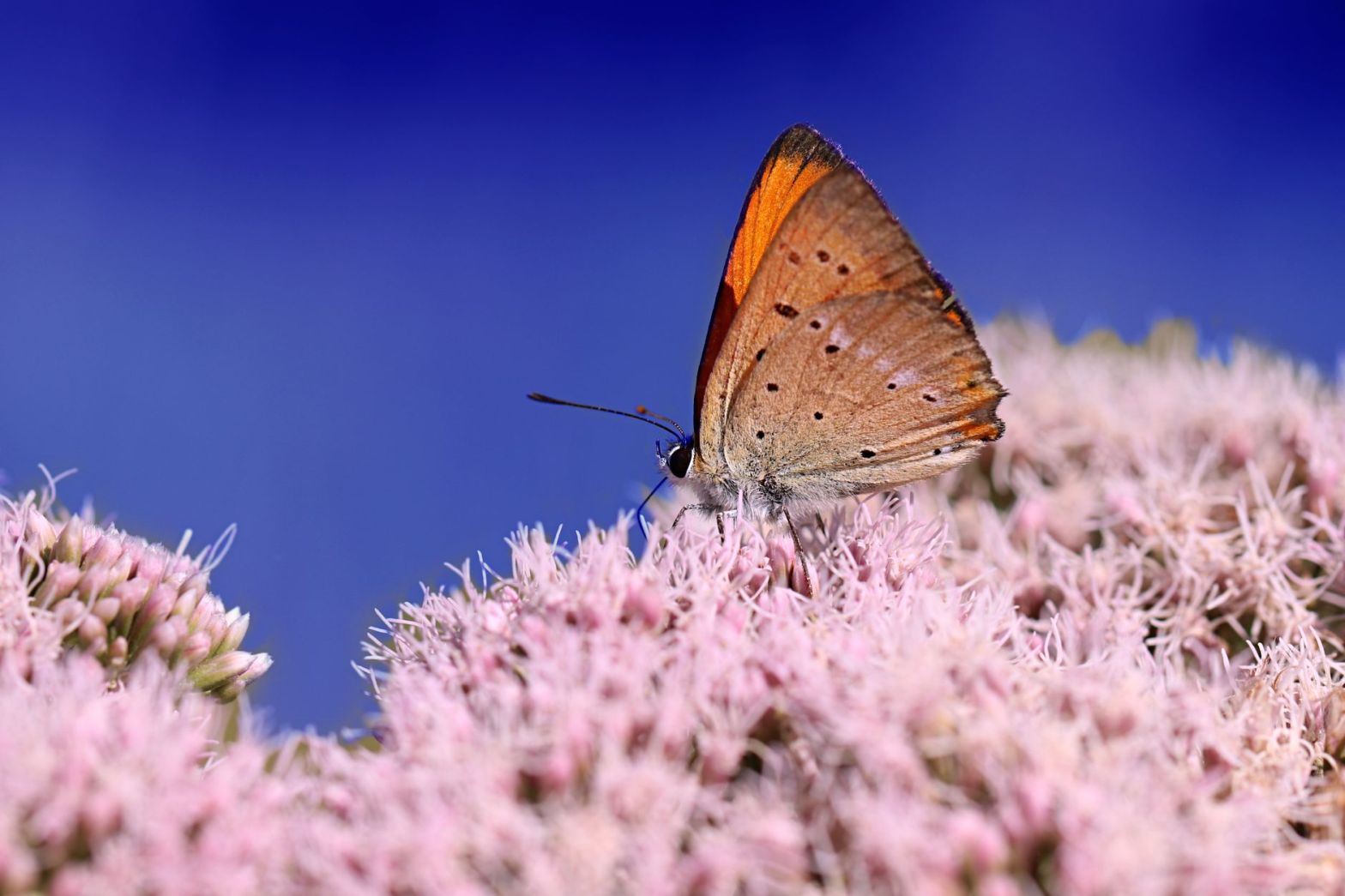
Pink butterflies may exist, but they are extremely rare…and should be cherished if encountered. Outlife Expert
“I loved that movie. It was so romantic,” my mother started to talk about an old black and white film I think I remember seeing but can’t recall its name either. It’s where a woman waits on a hilltop waiting for her lover. While she stands there, we know, although she doesn’t, that he has been killed in a distant military operation.
“They promised each other they would meet there. It was their special place.” My mother’s eyes are welling up at this point. “Then she’s surrounded by these butterflies,” she continues, her voice breaking, “they just appear out of nowhere, fluttering around her. It’s so beautiful.”
I swear, if she starts full on bawling, I’m outta here. I mean, I can only take so much romance. I make a joke and change the subject.
My mom has been a voracious reader of romance novels for several years now. She left shopping bags of those books to me after she died that she picked up at thrift stores. They all seem to have absorbed the mood of those places—musty, old and lonely. I guess they were her legacy. I really find romance novels boring. I know there’s a formula to them and as a writer myself I realize the genre is not as easy as it appears. They’re all pretty predictable, ending on a high note; yet the paths are so circuitous it allows a sense of individuality to each story. Maybe I will take a few of those books to read, I thought. Couldn’t hurt.
I was not surprised when my parents began sleeping in separate bedrooms. I knew it was mainly because my mom spent long nights with her light on reading those books. She was a very affectionate woman and I believed those books soothed her and perhaps gave her a more attentive husband, even if he was fictitious.
She’d tell me that she believed, as many cultures do, that butterflies symbolize transformation and resurrection of a soul. “When I die,” she would proclaim, “I’ll come back as a butterfly and let you know I made it to the other side.”
This was perhaps the beginning of her descent into dementia, although I didn’t recognize it. I just thought she was being poetic. My Italian mother was always a believer in the spiritual realm, influenced by the church and by her grandmother who was considered the neighborhood healer during the Great Depression and had visions beyond the scope of reason. Neither of us thought that was an oddity, unlike my dad who thought we were both a bit bat crazy.
I remember mom telling me how she witnessed her grandmother having a seizure and when she came out of it, she told my mother what she saw. She claimed she witnessed her brother, who was in the military in Italy, thrashing around in the ocean. She cried, worrying he was drowning. Days later she received a telegram saying his military ship had been torpedoed, but he survived!
Mom was a young 80 when her dementia became too overwhelming for my dad to handle by himself and was brought to live in a nearby nursing home. She actually seemed happier to be surrounded by more people, conversation and the owner’s pet dog. They also offered more activities and outings than my father was able to undertake. Unfortunately, by then my mother was not mobile or able to talk. A shower accident contributed horribly to her death a year later.
After she died, my husband’s job ended which had brought us to California where my parents lived, and we returned to our home in Tucson, Arizona. We resumed our normal life, which included taking care of our garden of saguaros, mesquite bushes and oleanders.
That summer, while I was piddling around in the house, my husband came inside and insisted I go outside with him into the yard. “Outside” was not my favorite place to be in summer when the temperatures are in a feverish pitch but he was anxious to show me something, so I followed him.
He brought me to the oleander bush filled with pink blossoms and just stood there without saying a word. I commented on how pretty the flowers were, wondering why he was so fascinated by the oleander until I saw the blossoms move, then flutter. Realization came slowly. By every flower was a pink butterfly. The entire oleander was filled with pink butterflies—a plant that is extremely toxic to them as well as humans! But apparently, not to my mother.
My reaction was typical for me. I shut down; went back inside the house and continued with minor, unimportant chores before my eyes welled up and I started full on bawling.
Originally from Chicago, Marlene DeVere has traveled and lived in various parts of the country and in the Middle East, but she admits it has been the inner journey—explored through writing—that has been the most rewarding. Retired from a career in teaching, broadcast journalism and copywriting, she lives in Tucson, Arizona. Her work has been included in Root Smoke, FemiNICHE, Angels on Earth, Lowestoft Chronicle, and The Bad Day Book Anthology among others, including being a Finalist in the Bellingham Review’s Annie Dillard Award for Creative Nonfiction.
quietly within the blossoming day we are whispering te deum
reading spare scripture at noon in the sunshine
we are observing entire views in viewfinders in soft light on a high cloudy day patterns of te deum
back from visiting those corners of prayer noticing what changes quickly backward steps, stuttering blunders we chant te deum
after small animal hibernation the lonesome hedgehog, the secretive snail after praising seraphim and cherubin and folks holding steady we sing te deum
that same song for simplicity and repetition anaphora of stones and singing cedar trees the female oriole collecting gossamer strands of horsehair from farms we grow along with that bird while chanting: te deum, te deum
Liz Nakazawa is the editor of Deer Drink the Moon:Poems of Oregon. This is an anthology of 33 Oregon poets writing nature poems. Her own poetry has appeared in Willawa, Timberline Review, Amethyst, ahundredgourds and other publications.
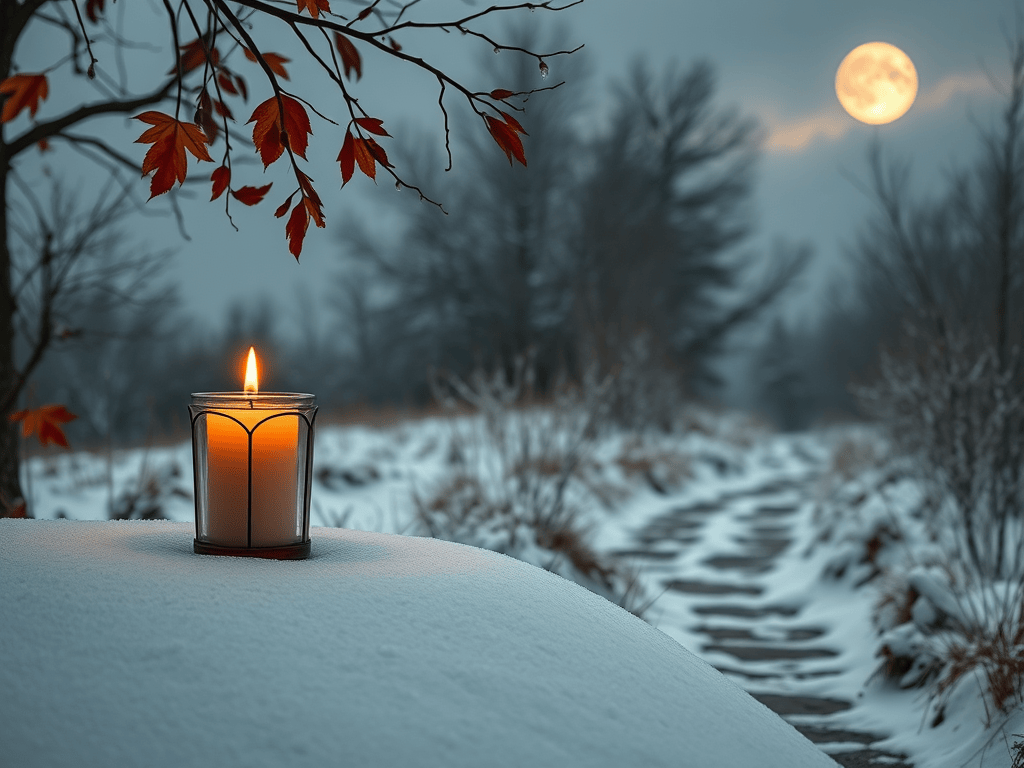
Fall The votive candle spins its last smoke into the soft tides of air. The moon slips away from the earth. Rain loses its grip on red stained glass.
Winter
My prayers have gone loose like wind sound that searches in a dense forest,
and the story I thought I was telling stops short at the windbreak.
Where do I walk now when the snow fills the old footpaths to the rangeland, and I don’t remember the names of the mountains anymore?
Sherry Weaver Smith writes poems inspired by her Catholic faith and the landscapes of the American West. Poems have received a Pushcart Prize nomination and a semifinalist award in the Narrative Poetry Contest (Naugatuck River Review). She is the author of The Wolf and the Shield: An Adventure with Saint Patrick. Her poems have been published in The Heron’s Nest, The Seventh Quarry, Vancouver Cherry Blossom Haiku Invitational, Panorama: The Journal of Travel, Place and Nature; and Amethyst Review.
It won’t blacken my skies with a swirling mass of beaks and wings. I couldn’t see through that flock, couldn’t feel the hot syrup of the sun dripping onto my shoulders, so I shot down every one of my feathered convictions. I’m done with anything that can cast a shadow. Give me translucence, no matter how warped the view: wings plucked off of dragonflies, rice paper that shreds when I touch my pen to it, undercooked sea glass, still see-through. Go on, consult with the augurs—the birds will allow it— and ask me if I want to know my fate. I’d tell you the truth, but really, the choice isn’t mine. The past is in front and tomorrow is a day waiting behind me. I’m always walking backwards into the future.
Cam McGlynn is a writer and scientific researcher from Frederick, Maryland. Ever since she was trapped in a deflating moonbounce as a child, she’s been deeply suspicious of carnivals. Her work has appeared or is forthcoming in Rattle, Whale Road Review, Gordon Square Review, The Shore, and ONE ART, among others. You can find her at pinkpossumclub.bsky.social or cam_mcglynn on Instagram.
I drop my heavy suitcase on the wooden floor and survey the room. A double bed, chair, fold-up writing table, and a closet too small with too few hangers to accommodate the outfits I’d brought for the week-long Hollyhock writing retreat. No worries. I’ll make do.
A small passage leads to a bathroom and another door which opens into a large room with three beds, a kitchen sink, wooden counters, and a fridge. There are no guests yet, but I’ve checked in early. I may be sharing a bathroom with three other people. From within, entitled Judy rears up, sparking that familiar nudge of irritation. I dampen the five-year-old down, reminding her this is not a usual vacation. We’re here to grow. We’re trying to find our way into a new sense of purpose. Away from the recent burden of emptiness and aloneness.
The wound deep inside throbs. I sit with it, refusing to do what I have done most of the sixty-plus years I have lived. I will not flee. I will not discard these unpleasant sensations or dissociate to my usual happy-happy Judy self. I will stay with the discomfort reminding me of my recent losses because I understand I must move through my pain if I am to grow.
Five months ago, my soul mate of over forty years died. I felt his death as if we were still married. As if we hadn’t separated sixteen months before, him moving to Thailand while I stayed behind on Vancouver Island. My body responded to his death five days before I received the news. Thirty-thousand feet in the air, on a flight to Mexico with a woman friend, unreasonable bouts of tears flooded my body. I dismissed the weird episode, thinking myself overwhelmed to be visiting the country I’d only ever visited with him.
During the next five days in Mexico, I became confused when sudden bouts of grief left me feeling disorientated. Surprising salty tears appeared out of the blue as I splashed in Bahia de Banderas Bay. In Sierra madre natural pools, my tears mixed with crystal clear water. I sobbed on the rocking back of a horse as we rode through the Mismaloya countryside, back to the hotel, where I finally discovered why my body was behaving so strangely. A Facebook text revealed the news. Roelof had died in Thailand, his death coinciding with that first spate of tears thousands of miles from where his body lay.
In Hollyhock, almost six months later, I still reel from the shock of loss. His death allowed me to finally grieve, to feel fully the impact of separating from the man who changed in my eyes as I began my healing journey. It had taken me ten years to extricate my slowly awakening self from his grip. I feel the tug still, the ties woven into the fabric of my being. When I left him in September 2024, I hadn’t allowed myself to fully grieve the loss of my future with the man I’d been in love with for so long.
I coped after the separation with my familiar survival tactic, numbing myself. I blocked him from my life, terrified co-dependency and trauma bonding would allow him the opportunity to return into my life. Early in my twenties, he’d been my anchor when family dysfunction drove my family and me apart. He’d helped me survive the unthinkable rejection of my parents and siblings. Our mutual childhood traumas created a pathological bond, a bond that eventually led to suffering.
When I finally acknowledged he’d become my chain, I physically extricated myself from the relationship, but we were still woven together, his presence with me. Even my work as a family physician seemed intertwined with our history of togetherness. When he died, I floated free, but without purpose. I felt unmoored. Free, but lost. I am skeptical of this writing retreat being able to heal this deep a wound. My body feels the urge to flee, but I actively resist the urge to leave for home to wallow in that recurring state of aimless flatness. Instead, I walk through the wooded grounds over fallen leaves, stones, and twigs to our first gathering.
I meet with eighteen other writers for a dinner on the deck. The ocean glitters. Seagulls, eagles, and cormorants swoop in invisible currents. Herons wade through low tide. Crows join the excited chatter mingling with the clatter of cutlery. I’m roused by fellow writers who dazzle me with their conversations. The encounters lift my spirit, but the in-between spaces reek of a sense of not belonging. Apartness.
On the second night we meet in a high-ceilinged room, eighteen women and a man settled on the chairs and sofa arranged in a circle on the wooden floor. Our ages vary from twenties to eighties. Some writers have met on a retreat here two years before, but most of us are still shyly getting to know each other.
The late afternoon light filters through pine and fir trees. Herons and gulls call from the Salish Sea. Betsy Warland, white-haired, slightly built, and casually dressed, guides us into the space, a quiet force, her soft voice holding us with the authority of a trusted teacher. Shaena Lambert is beside her, her smile radiant with warmth and light. I am not the only one feeling held. This night, each of the writers share the stories we are meant to write. The courage they show in their vulnerability opens my heart.
Each day brings new gifts. The smells from a garden of lavender, stately hollyhock, primroses, dahlias, an unfathomably rich display of color amidst beds of vegetables. The diamond studded ocean and lush ancient tree growth surround us. Drops of conversation inspire opening lines to chapters of the book I’ve been struggling to write. For the first time in a while I feel excitement about my project, the seemingly impossible task of uncovering ways to manage intractable chronic pain. Perhaps I will after all be able to share what my patients and mentors have taught me. Maybe I can make a difference to those living with unresolved chronic pain.
My interest in emotional and physical pain has spanned decades, but it has been my writing journey that led me to the language of healing. Writers like Gabor Mate, Ekhart Tolle, and Brene Brown have shown me the common sources of pain. I’ve learned how unresolved traumas stubbornly persist until we face them, find ways to process them. The journey leads to that light that shines within us all, but to find our way, we need community. A sense of connection to the Universe. I long to find meaningful ways to help others, but the journey starts with the heed for personal transformation.
Hollyhock provides more magic on the third night when as a community we settle in for a long meditation. We share another sacred space. Sixty souls with one purpose. Tapping into the spirit of the divine. I emerge from the deep meditation to a twinkling sense of my own divinity.
The following day I am drawn to a Tarot reading, my first. The cards reveal wounds common to humanity, the impact of childhood traumas, how unhealthy attachments form when we bond to similarly wounded people. The cards also remind me of my desire to find purpose in my life. My Tarot guide emphasizes what I already know, we have it within ourselves to open our hearts to the universe and to love. We have within ourselves the ability to heal from past wounds. I can move on from my past.
Through no fault of their own, my parents were unable to provide me with a stable childhood. Even before I was born, traumas imprinted on my DNA. As my body grew, stress stripped the protective layer coating my genes, exposing the coding for future illness, including mental illness like ADHD, anxiety and depression. But genes are only a small part of my being.
Trauma memories and my wired emotional pathways respond to threat automatically, creating the thought patterns I believed reflected Me. That Me was ignorant of the Self, the deepest part of me connected to the Universe, that free spirit locked behind the repeated patterns of thought and behaviors. I was chained by automatic responses, the deeply embedded brain wiring sabotaging my ability to heal.
My hunger for love and acceptance drove me into the arms of a man my brain wiring recognized as kin, outwardly dissimilar to my father but wired eerily the same. Unrecognized shame and fear held me in an isolating relationship until I found writing communities. Writers shared their personal stories and nurtured me with their friendship. They began to chip away at my old identity. The I that saw herself as nonsocial. Unable to make friends. Through writing I began to find friends. I found safety. I opened again to family. The trauma bond between my husband and me weakened until I was able to cut the ties. Now I’m free to love and be loved. Free to find Self.
The retreat library offers a book, Ramgiri Braun’s, HEARTSOURCING, Finding Our Way to Love and Liberation. The Spiritual Teacher shares his personal quest. I am emotionally touched by his courage and relate to those moments when he reveals his own struggles. I reflect on the hours spent in my apartment, lying on a hard floor, bound by catatonia, staring at the underside of the desk chair, at the dust under the bookshelves, wondering if I will find the strength to move forward. Reminding myself life is supposed to be hard. This is me running toward pain to get through it.
I reach a passage in the book, Ramgiri writing about his physical response reading about his future guru, Neem Karoli Baba. Light fills my chest. Warmth and a feeling of bliss spreads through my body. Tears of joy stream down my face. I wonder if the suggestible part of me has succumbed to the words, but only for a moment. I won’t discount the way my body has responded to that feeling of deep connection to these souls. I can’t remember ever experiencing anything so powerful.
The book guides me with a feeling of light and love as I attend writing sessions and commune with kick-ass writers, teachers, gurus, socio-political and environmental activists, businesswomen, mothers, sisters, wives. The cave of my heart opens to these fellow journeymen. I feel a deep sense of community.
The final night, we hold a ceremony, each of us offering to a flame a piece of paper. Written on the scraps are the words of the things we wish to leave behind. My piece of paper holds the words ‘I am alone.’ The group of writers and the sacred island space have allowed me to realize I am with community. I have a purpose to seek Self and stay connected to the Universe. When those feelings of being alone surface again, I will remind myself of this experience.
The morning of my departure, I notice a brown leaf on the path. I bend to pick up the fragile object. I hold the delicate offering up to the light. A completely intact membrane surrounds interconnected webbing and spaces. The leaf represents to me my reality, my life with more space than form. Somehow, this precious object makes the journey back home, intact but forgotten in the car’s console.
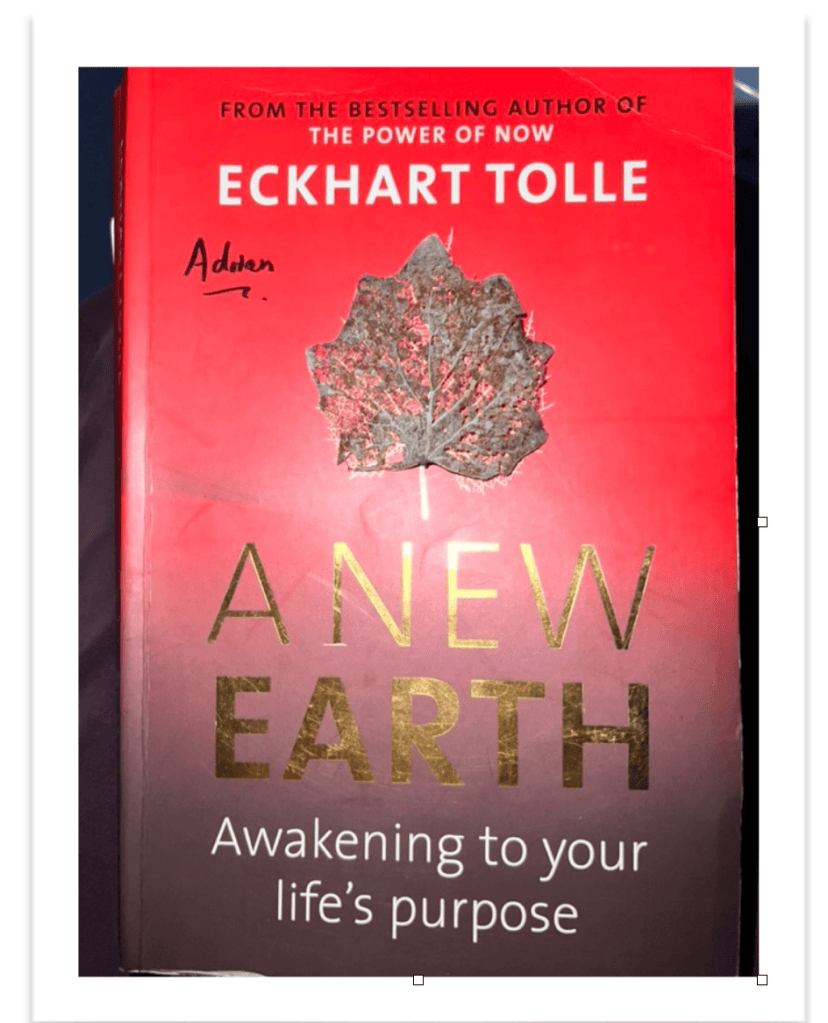
That night, I reach for Eckhart Tolle’s book, one suggested by Ramgiri. I notice what is on the cover. My heart fills with a now familiar feeling of bliss. I’m in my sweatpants, top but no bra, nevertheless I hurry out of my apartment, downstairs, to the parking lot. I fetch the leaf from the car.
Upstairs, I place the leaf over the image of the front cover. An almost perfect fit. A divine gift. I feel a deep sense of Self and a new awakening to my life’s purpose. A search for the God within me.
Judy Dercksen is a trauma informed family doctor, pain mentor, and the family doctor for Pain BC ECHO for pain. She has lived experience of complex PTSD and shares her knowledge of chronic physical and emotional pain in her writing.
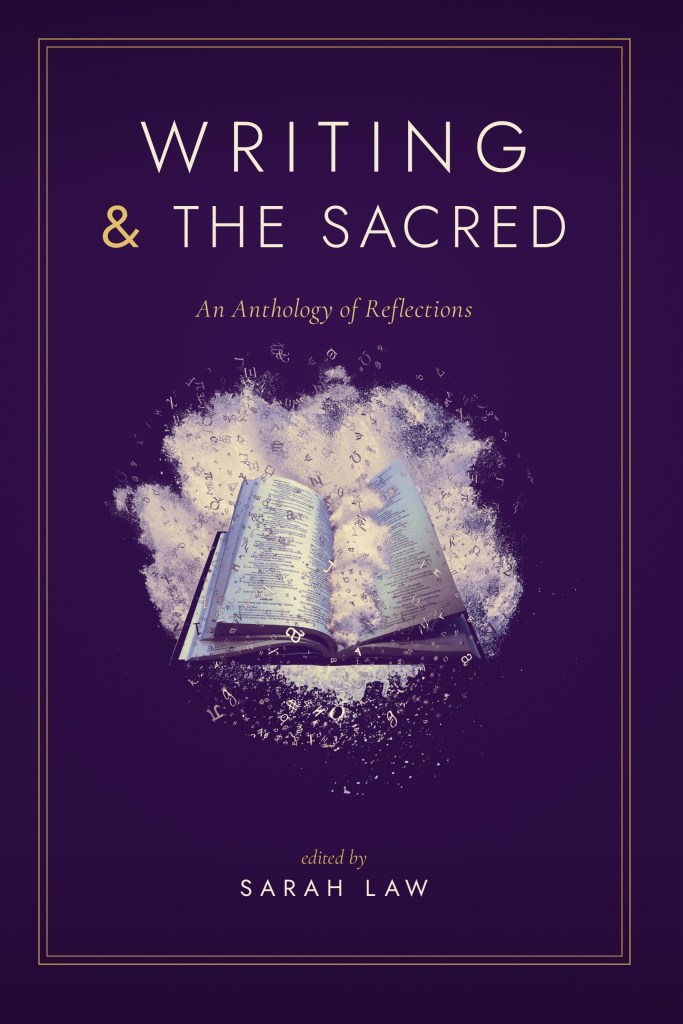
I’m delighted to share news of this recently published anthology from Amethyst Press! Writing & The Sacred: An Anthology of Reflections gathers together a wide range of reflections on writing and the sacred. Some first appeared in Amethyst Review; others were written in response to an invitation to contribute to this anthology. Their authors – poets, novelists, editors and creative practitioners – each bring a fruitful, personal engagement to the theme. Here are writers for whom language is holy in itself, and writers for whom the daily practice of writing is a spiritual discipline. Some listen for the sacred in silence, or trace it through loss, illness and the natural world. Drawing on Christian, Jewish, Vedic, shamanic and pre-Christian sources, these essays offer food for thought and contemplation to anyone who writes, reads or prays.
With contributions from M. Anne Alexander · Chris Anderson · Elizabeth Jarrett Andrew · Jane Angué · Roselle Angwin · John Janelle Backman · Lizzie Ballagher · Sue Brice · Carolyn Chilton Casas · Johanna Caton, O.S.B. Michael Centore · David Chorlton · Tara DaPra · Frank Desiderio · Keren Dibbens-Wyatt ·Clive Donovan · Diana Durham · Jenna Wysong Filbrun · Patricia Furstenberg · Mary Ellen Gambutti · Laura E. Garrard · Maryanne Hannan · James Harpur · Lory Widmer Hess · John Claiborne Isbell · Bethany Jarmul · Jane Keenan · Stephen Kingsnorth · Janet Krauss · Irina Kuzminsky · Marie Laure ·Jane Liffen · Viv Longley · Tony Lucas · Veronica McDonald · Marjorie Maddox · Tim Miller ·Matthew Pullar · Diana Raab · Kathryn Sadakierski · Wally Swist · Chuck Thompson · Lynne Wycherley
With an introduction by Editor Sarah
ISBN 978-1066864508. Available via Amazon as paperback and Kindle ebook now:
There is a stillness that’s reassuring, one that is unnerving.
It’s hard to tell the difference from the way the branches move
as a prelude to each. As though the echo of a butterfly wing is waiting to be heard.
I think of the I Ching – the randomness of right meaning found in how
the stalks fall, the art of interpretation, how right can become wrong.
I notice a stillness in the air. Something this way comes.
I smile as though what’s arriving is an answer
to a koan yet to be given.
Byron Hoot was born and raised in Morgantown, West Virginia. He now lives in The WILDS of Pennsylvania. Still in Appalachia where the hills and valleys, streams and lakes, the people formed, and still form him, and give what he writes about. His poems have appeared on Vox Populi, Pine Mountain Sand and Gravel, Keystone Poetry, The Watershed Journal and other publications.
As God knows all, he knows full well of my Control; how even at my most sincere I’m actually asking for a grace I can corral and modify Into a thing I need not fear The status quo might rattle or displace.
How often do I ardently assure
Him that his Holy Will is all to me
Only to find that, should said Holy Will
          Suggest I this or that abjure
          For my soul’s inner harmony,
My ardor’s quickly set aside to chill.
But he’ll have none of it. His love compels.
It pushes through my soul, so holy, rude,
So confident of its sublimity.
          Dismissive of those tiny hells
          I cling to in my lassitude,
He drags me screaming toward divinity.
Jeffrey Essmann is an essayist and poet living in New York. His poetry has appeared in numerous magazines and literary journals, among them Dappled Things, Amethyst Review, America Magazine, and The Society of Classical Poets. He is a certified catechist with the Archdiocese of New York, a Benedictine oblate of St. Mary’s Abbey in Morristown, NJ, and editor of The Catholic Poetry Room.
Breaking the self as wunderkind, as child in stigmata. Fests decayed to festive, restored sporadic in waves de l'estiu, in honour of the prime disfigurement.
There to build in stone beyond white, memory, love midoneother dependent. Strung resemblance to the motley avaricious Word. (That is the root of nuptials, that is in the old sense grotesque). Strong echo of the branch impervious, wherearound the bees theirselves configure.
In bearings from the quaint apocalypse, agonrite of outerwit, return of number to numbers, return of Sight to sight. From accidence of hollander, incunable divine.
Adam Walters is originally from Greater Manchester and currently based in London. They have previously had poems published by, among others, Brussels Review, Sink magazine and Just Keep Up.